Sign-ups are open. You can start from the sign-in page.
However much you talk, the plan stays one.
A board Claude writes to. Instead of a fresh summary every conversation, it accumulates into a single plan.
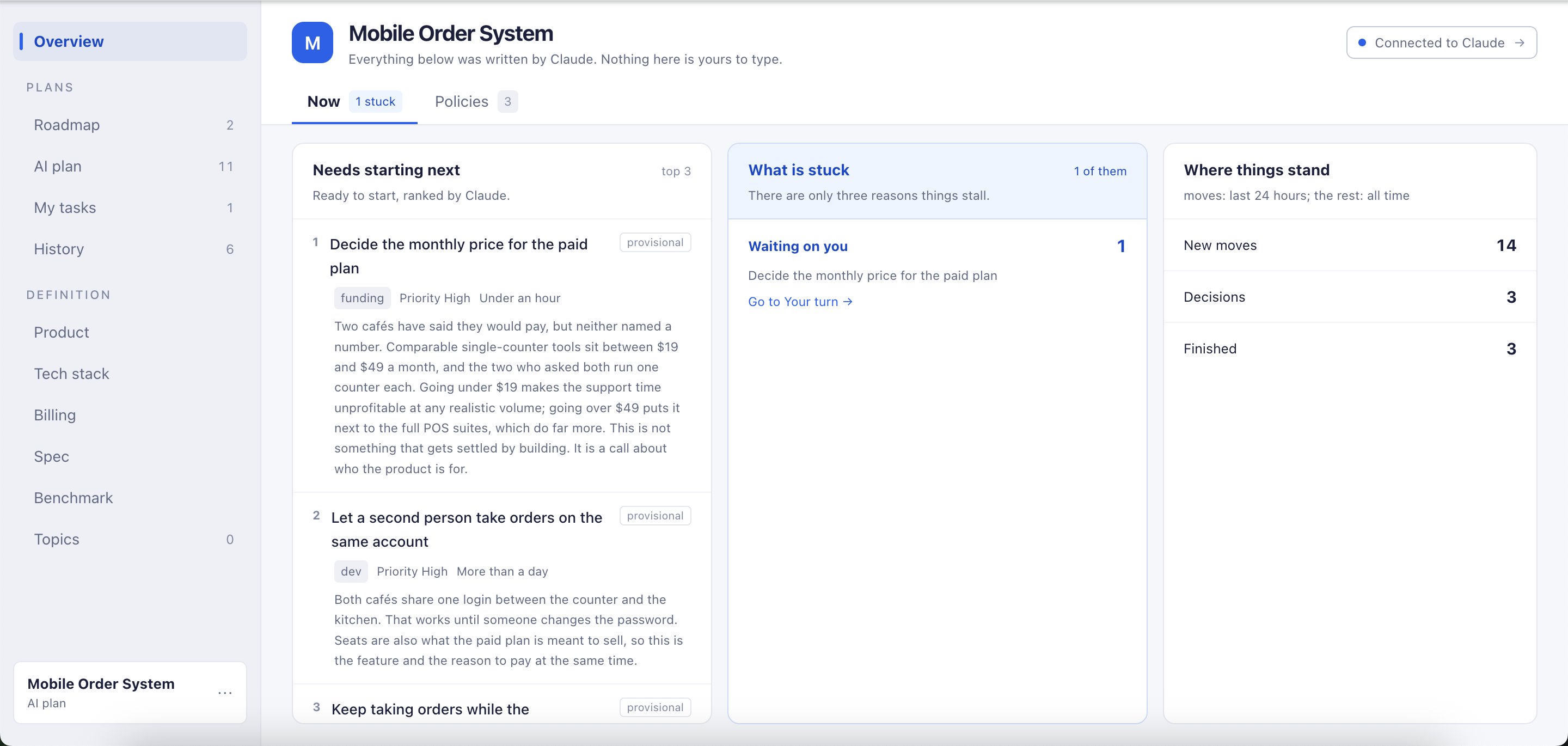
Screens are examples. The board in them belongs to one person building a mobile ordering system.
There is no box for writing a plan from scratch.
No chat panel, no ticket form. You correct; Claude does the writing.
FROM THE BOARD ITSELF
Everything below was written by Claude. Nothing here is yours to type.
That line sits under the board's name on every board.
Talk all you like — the plan piles up in one place.
The board is not another place for you to write. It is where what gets written arrives.
You talk to Claude
In whatever app you already use. This board never comes up.
Claude writes here
Goals, moves, reasoning, and what would reverse them.
You come here to decide
Read it, fix it, set the order. One click each.
Connect Claude once.
Issue one connection URL and register it in the app you already use. After that, the board never comes up in the conversation.
It connects over MCP, the shared method Claude uses for outside tools.
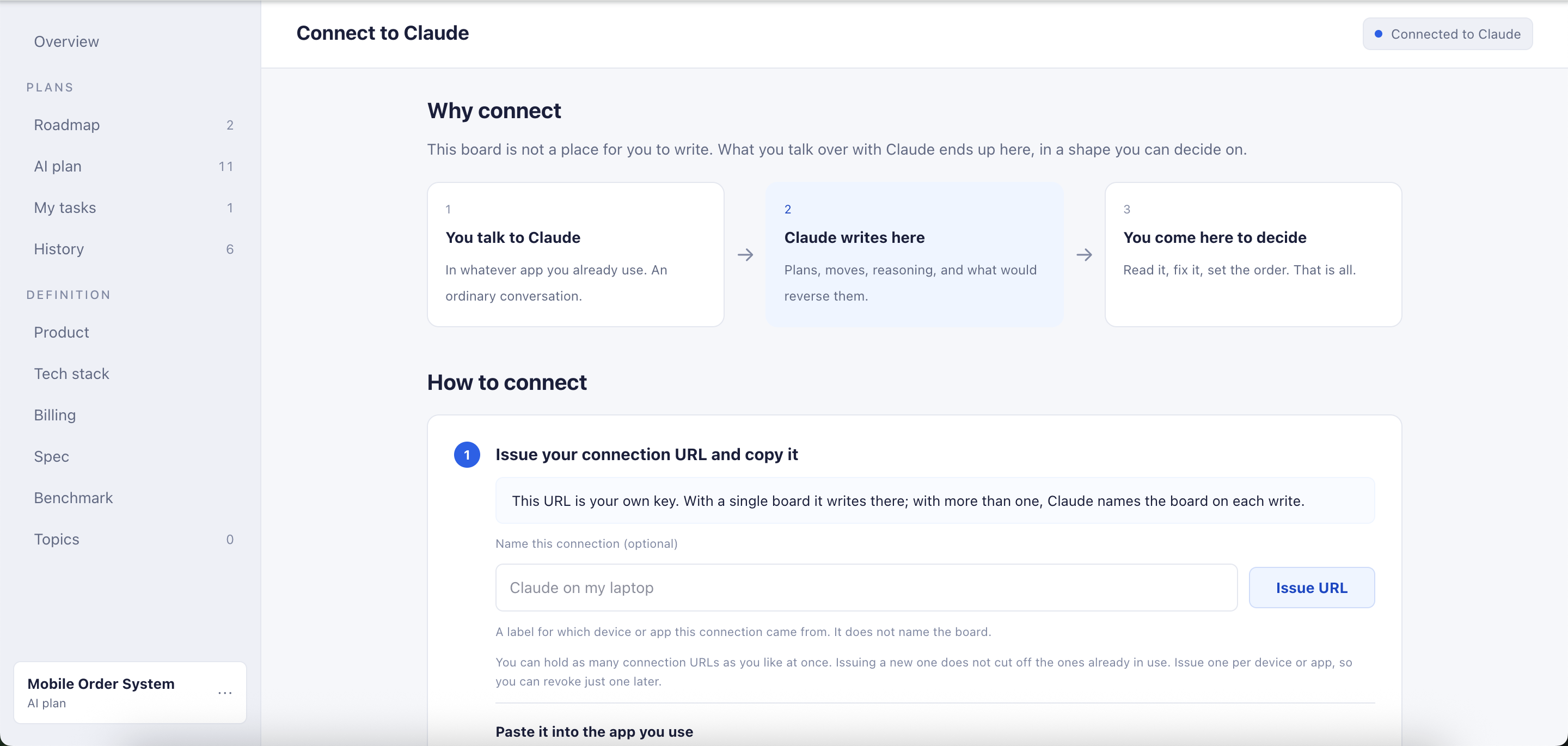
Connecting means registering one connection in Claude. Claude Code is not required — though a connection from Claude Code is the one we have actually tested end to end. Claude desktop and claude.ai in the browser register the same way, but we have not verified them.
Not using Claude yet? You can start free at claude.ai.
WHERE YOU ACTUALLY SPEND YOUR TIME
Most of it happens in the conversation, not on the board.
You keep working in Claude Code. The board is what the two of you point at when the plan comes up.
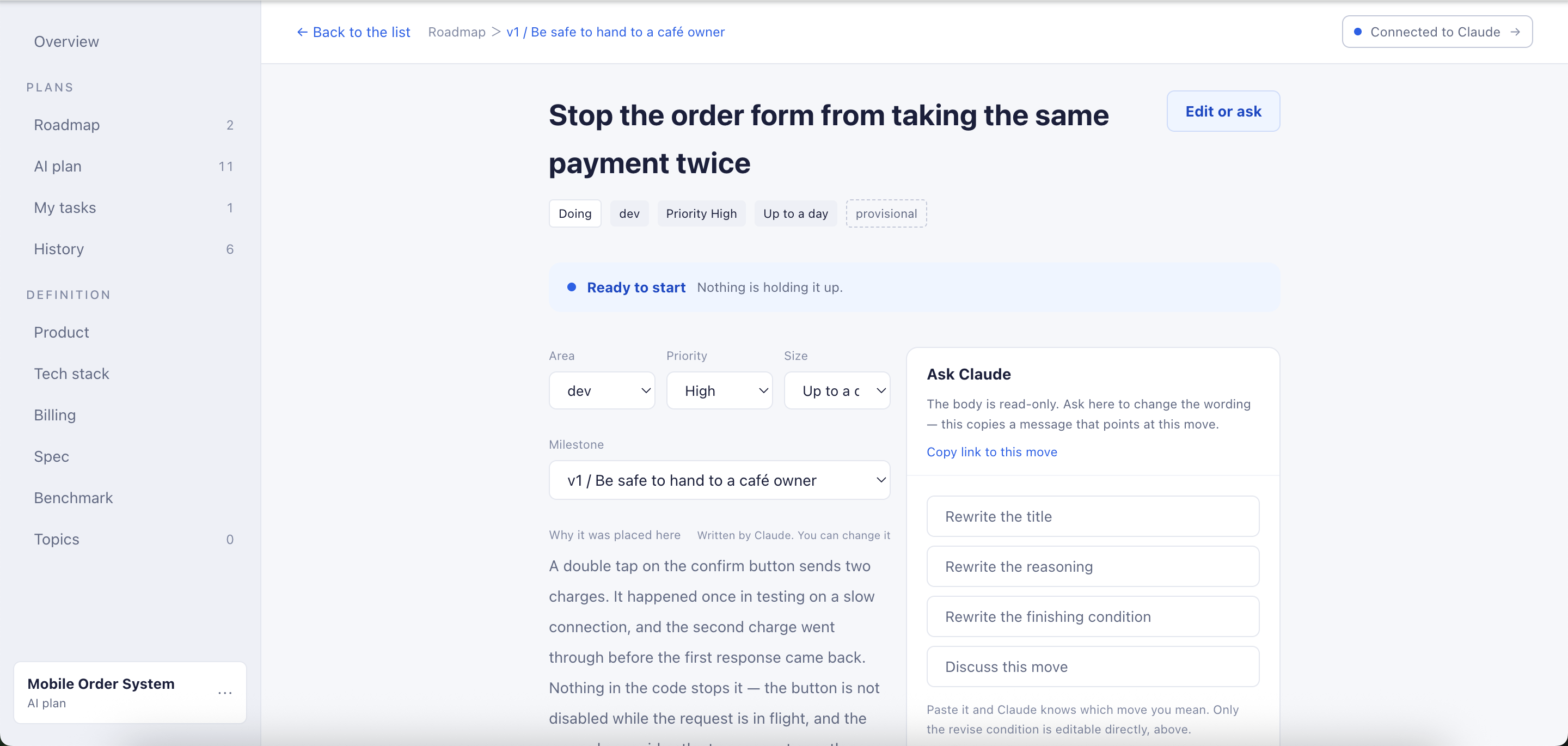
Stop the order form from taking the same payment twice
Decide the monthly price for the paid plan
The board is the shared reference.
Neither of you retypes the plan into the conversation. Claude points at a move; you open it when you want to change it.
The next session reads the same thing.
Close the terminal, come back tomorrow, connect from another machine — what was decided is still decided.
The conversation above is an illustration of the exchange, not a screenshot.
WHEN IT MATTERS
Three moments where a branching plan costs you.
3 days away
The board opens on what is in progress and how many days each has sat still. The trend of finished and remaining work joins it as soon as the first task is done.
You disagree with the AI
Every call carries its reasoning. What would reverse it comes with it when it is written. One click changes it — no confirm dialog, no save button.
Another session decided the opposite
Decisions stay, with their reasoning. Whoever opens it later — and whichever session connects next — reads the same thing.
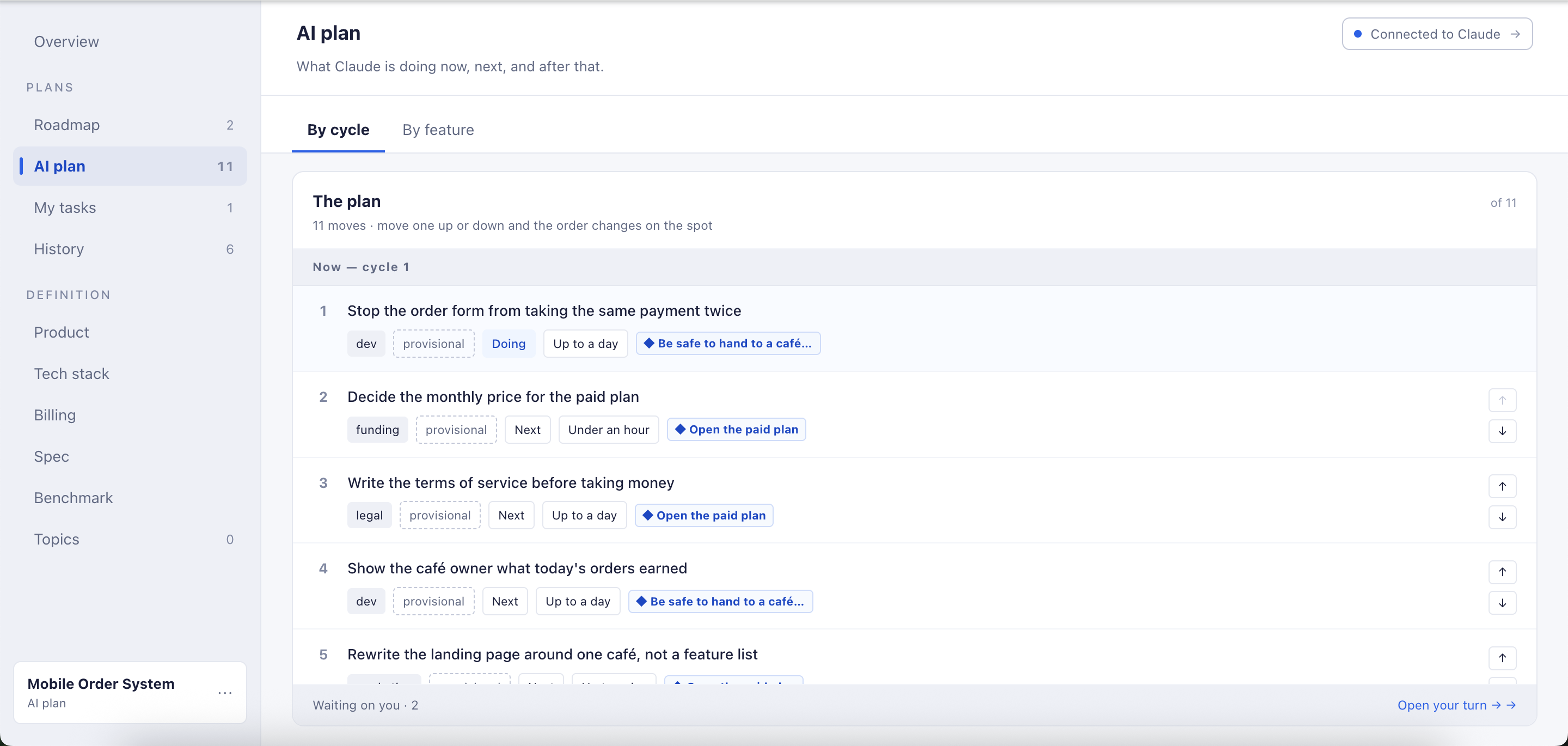
IT ACCUMULATES
Now, next, and after that — in one order you can change.
Claude's plan arrives as cycles, not as a new document each time. Move one up or down and the order changes on the spot.
Questions
- Does it work with anything other than Claude?
- Claude is the only one we have verified. The connection uses MCP, an open method, so other assistants may well work — we have not checked. Supporting one properly beats supporting four halfway.
- Does it read my code?
- No. It never touches anything on your machine. What is on the board is what Claude wrote there, plus whatever you change yourself — titles, reasoning, conditions, and links you allowed.
- Can I take my data out?
- Yes. From account settings you can export the whole board as JSON in one click, on the free plan too. The contents are yours and we do not intend to lock them in.
- When can I use it?
- There is no date. Publishing a date we have not committed to would itself be a promise we cannot keep. Join the waitlist and we will write when it opens.
You will not have to say "tidy this up" again.
Connect Claude once. From your next conversation, it starts landing on the board.